- calendar_today August 12, 2025
.
Washington and New Delhi had enjoyed one of the warmest and most productive bilateral partnerships in the post–Cold War world for over two decades. Now the strategic alliance, which took years to build, is in deep trouble.
“The relationship is going through one of its most serious tests of the last 25 years,” said Evan Feigenbaum, a South Asia analyst at the Carnegie Endowment for International Peace. “We’re in a situation in the U.S.-India relationship where the premises and assumptions of the last 25 years — that everybody worked very hard to build, including the president in his first term — have just come completely unraveled. The trust is gone.”
The deterioration in relations has picked up pace since Trump imposed tariffs on Indian goods in April over New Delhi’s refusal to cut back on purchases of Russian oil despite the war in Ukraine. The tariffs, which began at 25 percent and will double to 50 percent from August 27, appear to have had the opposite effect on India, which has drawn closer to Moscow and even Beijing.
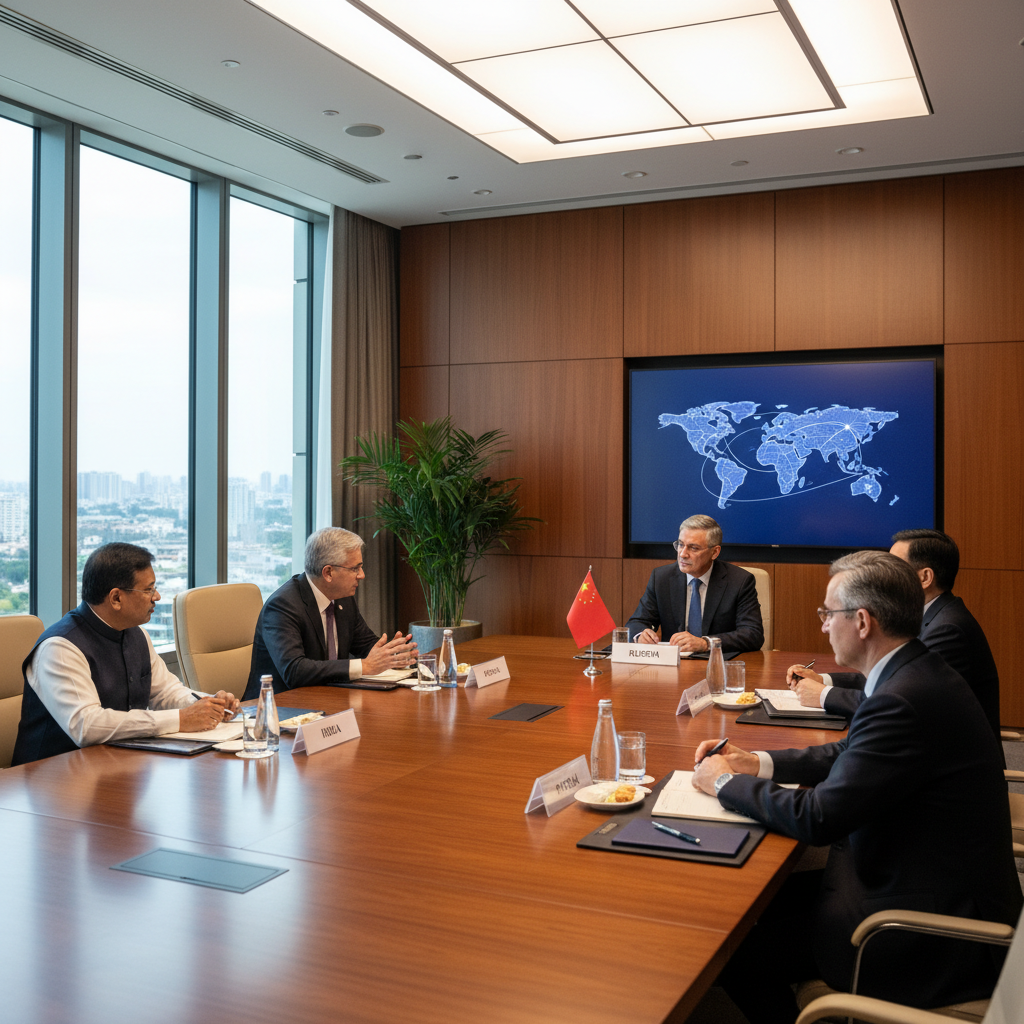
India’s national security adviser recently visited Moscow, foreign minister Subrahmanyam Jaishankar has held high-level talks in the Russian capital, and Chinese foreign minister Wang Yi just wrapped up a meeting in New Delhi. Modi is expected to make his first visit to China in more than seven years, while a Moscow trip is also in the offing, with Russian president Vladimir Putin reportedly keen to host him before the end of the year. According to analysts, this rapprochement with India’s east is more than just words.
Indian public opinion has turned against what many consider U.S. interference in New Delhi’s internal affairs. “They’re signaling very clearly that they view that as interference in India’s foreign policy, and they are not going to put up with it,” Feigenbaum added.
Indians were hesitant to resume Russian oil imports early in the war, but state-run refiners then returned to Moscow after it offered discounts of between 6 and 7 percent. Now, India is set to import 35 percent of its oil from Russia, as opposed to 0.2 percent before the war in Ukraine. Russia, for its part, has ramped up offers. Deputy Prime Minister Denis Manturov said Moscow will continue to ship crude oil, oil products, thermal coal, coking coal, and even see “potential for the export of Russian LNG.”
Trump’s tariffs are not the only reason, however, that India has tilted away from Washington. “We’ve seen indications for almost a year of India wanting to ease tensions with China and strengthen relations, mainly for economic reasons. But the Trump administration’s policies have made India want to move even more quickly,” said Michael Kugelman, a South Asia analyst at the Washington-based Wilson Center.
Some of these steps are more for optics and for “impressing the global audience” and are less likely to “translate into concrete and long-term policy changes,” he added. But as Feigenbaum noted, “India is going to double down on some aspects of its economic and defense relationship with Russia — and those parts are not performative.”
Indeed, New Delhi has already been cutting its dependence on Russian weapons and buying more American, French, and Israeli arms. But after Russia invaded Ukraine, it has stepped up its energy purchases from Moscow. This “confirms what many in New Delhi have felt but hoped not to see in this year’s Russia–Ukraine war,” Kugelman said, referring to “the notion that the U.S. can’t be trusted, whereas Russia can — because Russia is always going to be there for India no matter what.”
By continuing to buy Russian oil, Modi has also secured a domestic political win by underscoring his professed determination to do “whatever it takes” to protect the livelihoods of farmers, small businesses, and young job-seekers. “There is no way to sugarcoat this,” Kugelman said. “This is an issue that has real salience in the country and to Modi’s political base.” Modi, he added, “has already bent over backward for the U.S.” by making concessions on tariff reductions and the repatriation of Indian workers during the pandemic. “Because of those concessions, India needs to be careful about signaling further willingness to bend. This is one reason there was no trade deal — Modi put his foot down.”
Feigenbaum, for his part, said in Washington, the administration is “livid.”
Peter Navarro, who worked at the White House as the Trump trade adviser, wrote in the Financial Times that “opportunistic” Indian oil purchases were “deeply corrosive” to the U.S.-India relationship. “Tariffs were necessary to hit India where it hurts — its access to U.S. markets — even as it seeks to cut off the financial lifeline it has extended to Russia’s war effort,” Navarro wrote.
So Far, So Good
Tariffs and oil politics have taken a heavy toll on the Washington-India relationship. But the significance of the rupture goes beyond the economics, and New Delhi’s moves suggest an acceptance of Russian actions.
Even after the tariff was first imposed, New Delhi and Washington had managed to compartmentalize differences over Ukraine. They had done this, for instance, in 2019 after a series of border clashes, some of which left more than 20 Indian soldiers dead. Analysts say now it has become more difficult.
In the past, however, both countries have maintained goodwill by separating critical issues. “Back then, Modi did not have much wiggle room. Now, the Indian economy is on the mend and Modi feels a little bit of love from both China and Russia,” Kugelman said.