
- calendar_today August 16, 2025
.
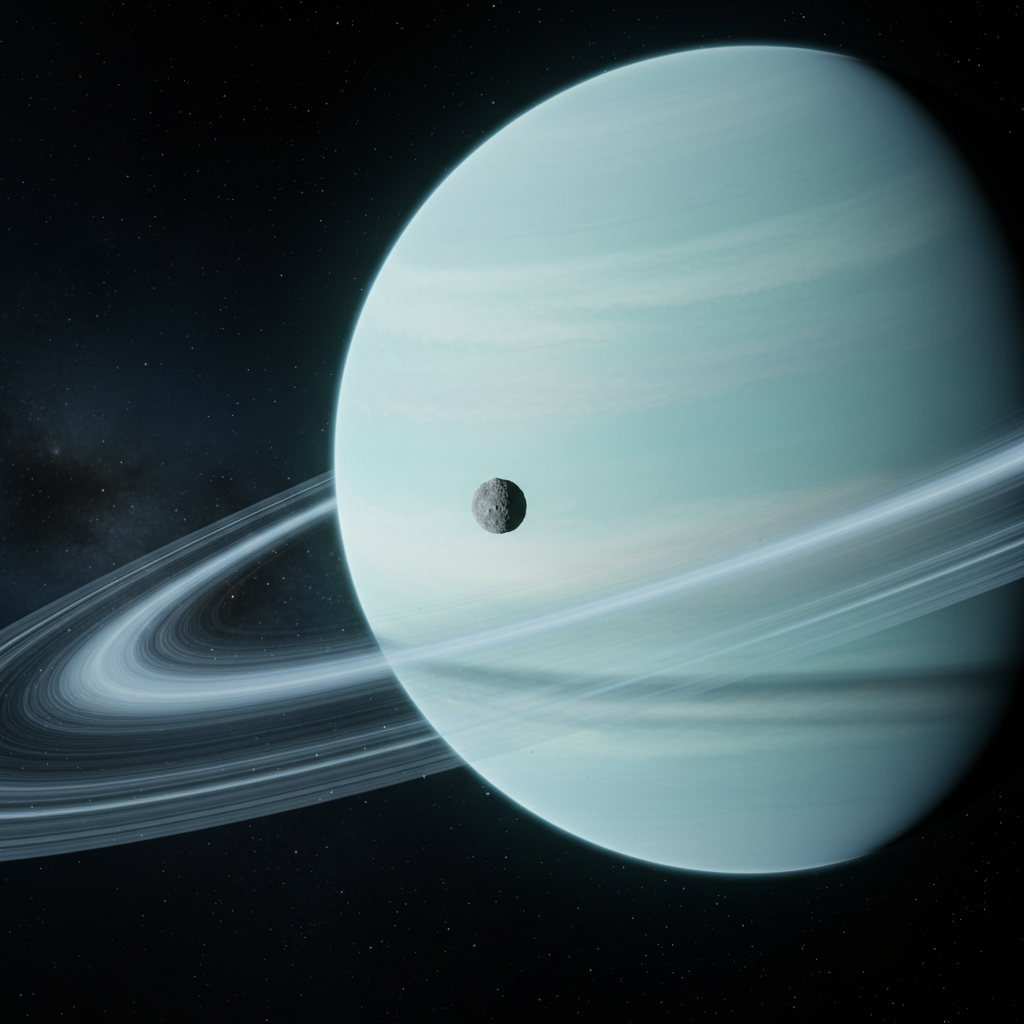
The James Webb Space Telescope (JWST) has detected an as-yet-unseen moon orbiting Uranus, the second-largest planet in our solar system and the seventh from the Sun. The discovery raises the total number of known Uranian moons to 29 and could help solve a mystery about the ice giant’s complex ring system. Scientists believe even more moons orbiting Uranus have yet to be discovered.
NASA’s JWST spotted the elusive natural satellite, which measures a mere 6 miles (10 km) across, on 2 February 2025 as part of a sequence of long-exposure images lasting 40 minutes each. The images were obtained by Webb’s Near-Infrared Camera. The newfound moon, so far unnamed and provisionally designated S/2025 U1, is one of the smallest moons ever found around Uranus. Astronomers believe its small size and the bright reflected light of Uranus’ rings helped hide the body from previous missions and ground-based telescopes. The little moon was even too dim for NASA’s Voyager 2 spacecraft to spot when it flew by Uranus 39 years ago.
“This is a small moon but a significant discovery,” said Maryame El Moutamid, an astronomer and a lead scientist at the Southwest Research Institute’s Solar System Science and Exploration Division in Boulder, Colorado. El Moutamid is principal investigator for one of four Webb programs studying Uranus’ rings and inner moons. “The discovery will help us study one of the biggest mysteries about Uranus and is a great example of how Webb is helping us to go beyond what was known from previous missions,” she added.
Situated about 35,000 miles (56,000 km) from the center of Uranus, the moon orbits on an almost circular path close to the planet’s equator. It is located between the known moons of Ophelia just outside Uranus’ main ring system and Bianca. Astronomers think the small moon formed close to where it is now, based on its orbit.
The small moon’s orbit was obscured because it is dark, so small and moving so quickly that it was difficult to distinguish against Uranus’ bright glare and the planet’s rings. Observations made by previous telescopes have spotted no such small moon where it is now located. Webb’s capability to sense even faint infrared light helped reveal it. In fact, in its first few months, the telescope had already offered tantalizing glimpses into Uranus’ rings, weather, and atmospheric composition.
Discovered Uranus Moon
Astronomers have unlocked another piece of the Uranus puzzle with this latest find. The planet’s ring system is much more complex than researchers previously imagined. Astronomers believe S/2025 U1 and the dark clumps in the ring system may share a common origin. Fragments of a parent body smashed apart long ago may have formed both. “The discovery raises questions about how many more small moons remain hidden around Uranus and how they might interact with its rings,” El Moutamid said.
Today, we know Uranus has five major moons—Miranda, Ariel, Umbriel, Titania, and Oberon—plus a large group of smaller satellites. S/2025 U1 is only the 14th small moon in the inner system. No other planet has as many small inner moons packed into that space, which is a mystery to astronomers. These small satellites orbit so close together that their orbits should cross, but somehow they don’t. Astronomers think the moons may shepherd Uranus’ narrow rings.
Scott Sheppard, an astronomer at the Carnegie Institution for Science, not associated with the new study but co-discoverer of one of Uranus’ moons in 2024, calls the new discovery “very exciting.” He says the object is very near the inner ring system, which makes it significant. He praises Webb’s sensitivity to be able to detect it.
In remarks provided by the SETI Institute, Matthew Tiscareno, co-principal investigator on the Webb Uranus project with El Moutamid, noted the discovery blurs the line between what we consider moons and rings of Uranus. “Their complex inter-relationships hint at a chaotic history. And yet this new moon is even smaller and fainter than the smallest known Uranian inner moons, which suggests there are many more still waiting to be found,” he said.
Historically, our view of Uranus’ moons is limited and has only been revealed over time. Voyager 2, which flew by Uranus on 24 January 1986, completed the first true inventory of the Uranian system, although only five moons had been known before (the largest ones) and four of them were known to be since at least 1787. Voyager 2 found ten small moons in the main system during its flyby, measuring between 16 and 96 miles (26 and 154 km) across. But then in 2003 ground-based telescopes and the Hubble Space Telescope discovered 13 even smaller moons in the inner system, measuring only 8 to 10 miles (12 to 16 km) across and even darker than asphalt. Uranus’ inner moons are thought to be made mostly of ice and rock, while its outer moons beyond Oberon are believed to be captured asteroids.
The future of Uranus exploration looks bright. In its planetary decadal survey published in 2022, the National Academies of Sciences, Engineering, and Medicine recommended NASA’s next large planetary science project be a Uranus Orbiter and Probe mission. A mission could fly as soon as the early 2030s, but NASA faces questions about how to fund the ambitious mission in a budget that has no money for planetary missions of that size. Such a mission would solve many of Uranus’ mysteries, such as the planet’s tilted axis of rotation and strange magnetic field, explore its active atmosphere and dynamic weather, and fly by some of the moon to look for ice worlds.
Sheppard, who is not involved in the new study, says there are many more moons as small as a few kilometers waiting to be discovered, possibly with the long-exposure JWST imaging and will probably be found when spacecraft return to Uranus. El Moutamid and her team will continue to refine the orbit of S/2025 U1 and search for more.
“Discovering a new moon around Uranus helps scientists understand how its strange system formed, sheds light on its rings, and prepares us for future missions like NASA’s Uranus Orbiter and Probe,” El Moutamid said.