
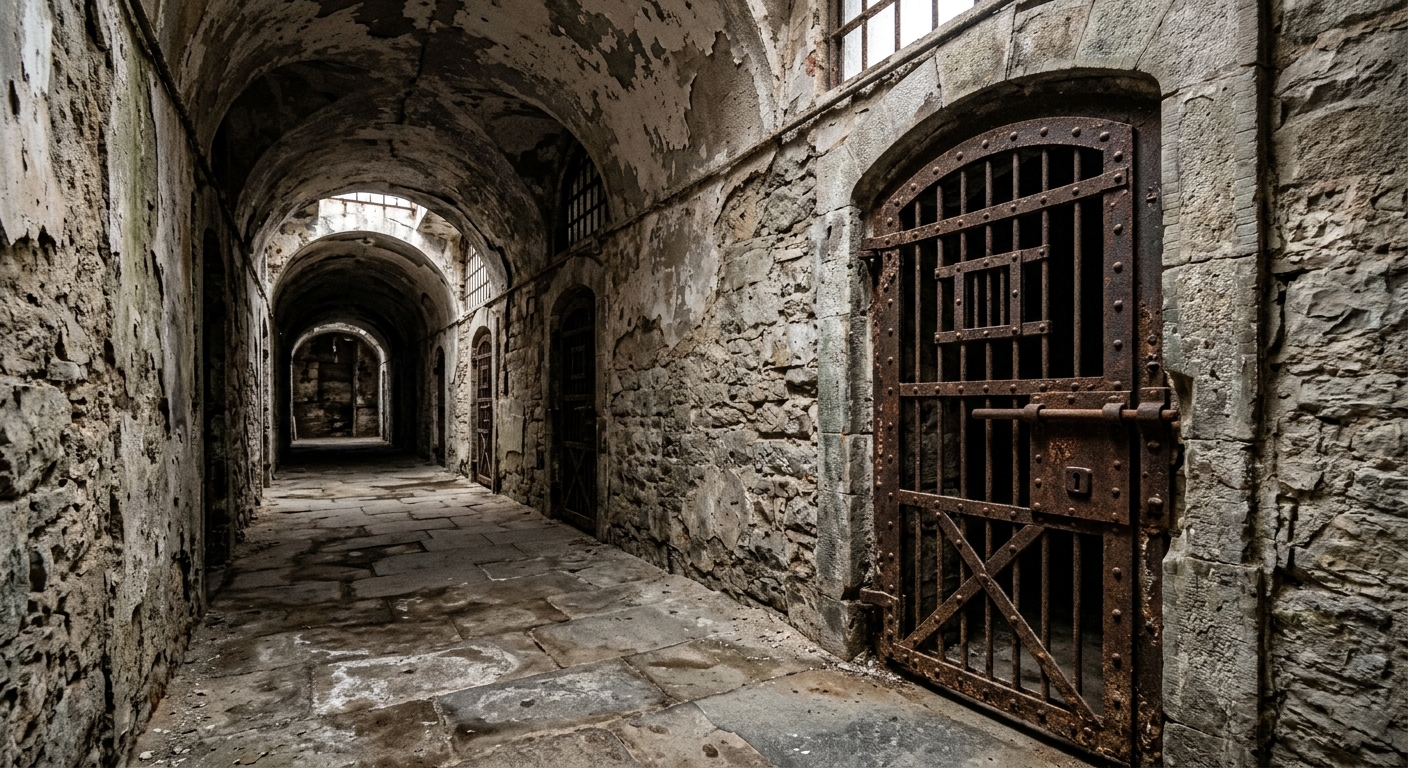
AI-generated illustration; not a photograph of the reported event.
- calendar_today November 9, 2026
PBS to Premiere 'Crime and Punishment in America'
PBS will premiere a new four-part docuseries, Crime and Punishment in America, on November 16. Produced by Ken Burns and directed by Lynn Novick, the series takes an in-depth look at the evolution of the United States criminal justice system, spotlighting Philadelphia’s notable influence through pioneering penitentiaries and key historical events.
Philadelphia: Epicenter of Early Prison Reform
The narrative begins on Sixth Street in Philadelphia, where the juxtaposition of Independence Hall and the former site of Walnut Street Prison embodies the nation’s longstanding debates about justice. The city was instrumental in early American discussions on criminal punishment and rehabilitation, initiated by figures like Benjamin Rush and Benjamin Franklin. Their group, the Philadelphia Society for Alleviating the Miseries of Public Prisons, played a crucial role in championing prison reforms and introducing new ideas such as solitary confinement.
From Public Punishment to Solitary Confinement
Before the establishment of prisons like Walnut Street and Eastern State Penitentiary, punishment in America was a public spectacle. Stocks and public executions were common, but reformers in Philadelphia pushed for change. In 1790, Walnut Street Prison opened with an experimental approach to solitary confinement, and in 1829, Eastern State Penitentiary followed, expanding the model to house 250 prisoners. While solitary confinement was viewed by some as a humane alternative, critics such as Charles Dickens condemned its effects after visiting Eastern State in 1842.
The Growth of Law Enforcement and Shifts in Justice
Alongside changes in incarceration, law enforcement in Philadelphia also transformed—from night watchmen to formal police departments—in response to increasing violence and social upheaval in the 19th century. Crime and Punishment in America explores these shifts, chronicling ongoing debates and changes in the justice system over four episodes spanning from America's founding through the modern era, including the Attica Prison riot.
Contemporary Perspectives and Persistent Challenges
The docuseries features commentary from Philadelphia District Attorney Larry Krasner, who discusses topics such as the Supreme Court case Gideon v. Wainwright, which established the right to legal counsel for all defendants. Krasner points to challenges public defenders face due to limited resources, arguing that inadequate support undermines the right to fair representation.
Director Lynn Novick frames the series around cycles of progress and backlash in America’s approach to criminal justice. The documentary highlights near-revivals of archaic punishments and debates about effective reform—drawing on events as recent as the Trump administration's consideration of live-streaming executions. Novick suggests that historic events and fears often push public opinion towards harsher punishments, but she maintains that revisiting history provides essential context for future improvement.
Looking Back to Look Forward
Through interviews, archival footage, and a chronological examination of reforms and regressions, Crime and Punishment in America prompts viewers to reflect on the assumptions underlying the criminal justice system. While Novick and the series do not prescribe solutions, they encourage a deeper national dialogue about justice, reform, and the enduring significance of Philadelphia’s legacy in the evolution of U.S. criminal punishment.
Source: phillyvoice.com.